Roman Telescope to Reshape Cosmological Models by 2030
Strategic Foresight
The Nancy Grace Roman Space Telescope's launch initiates a decade of unprecedented cosmological observation, promising to redefine our understanding of dark energy and the universe's expansion.
The starting conditions
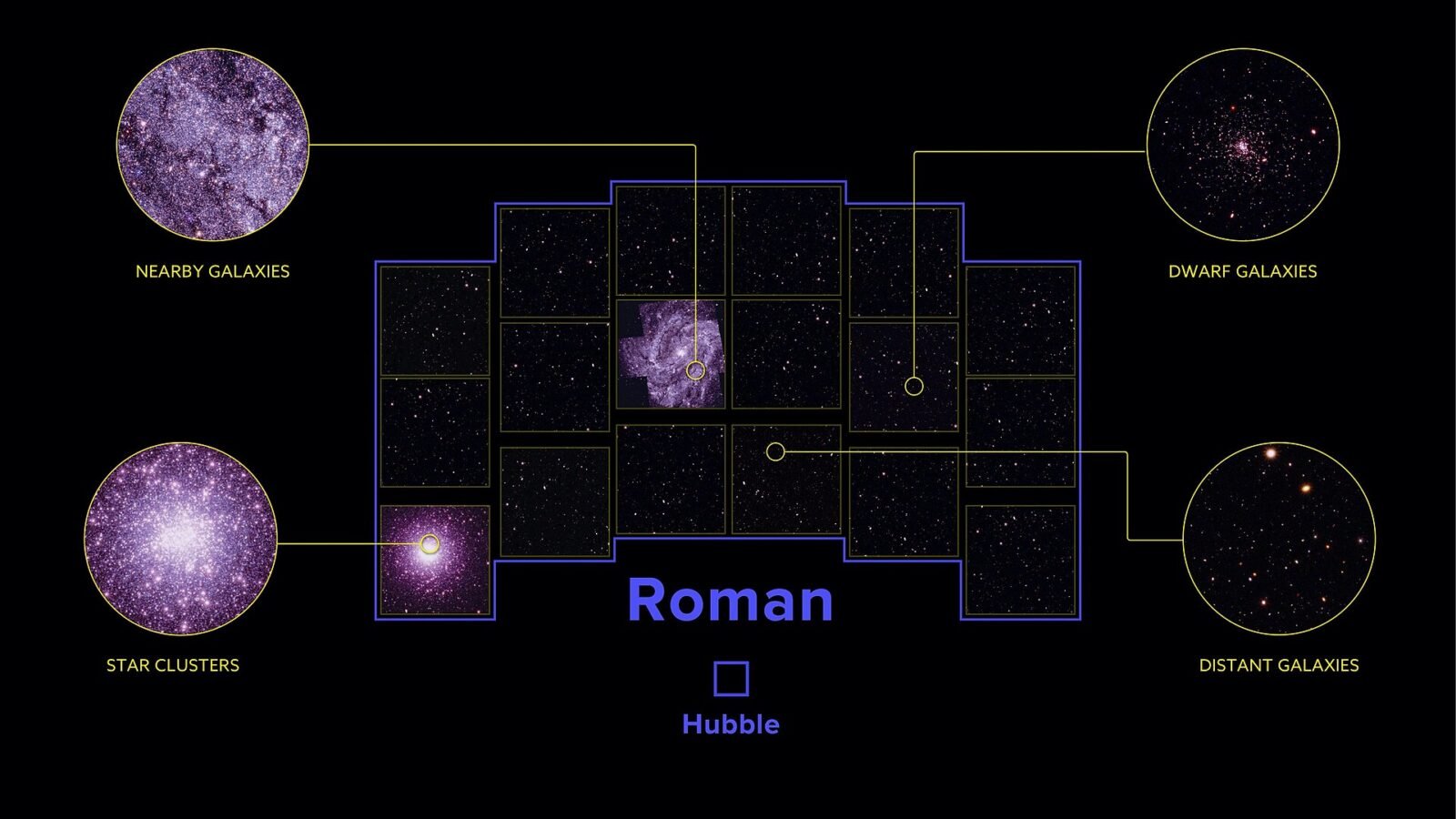
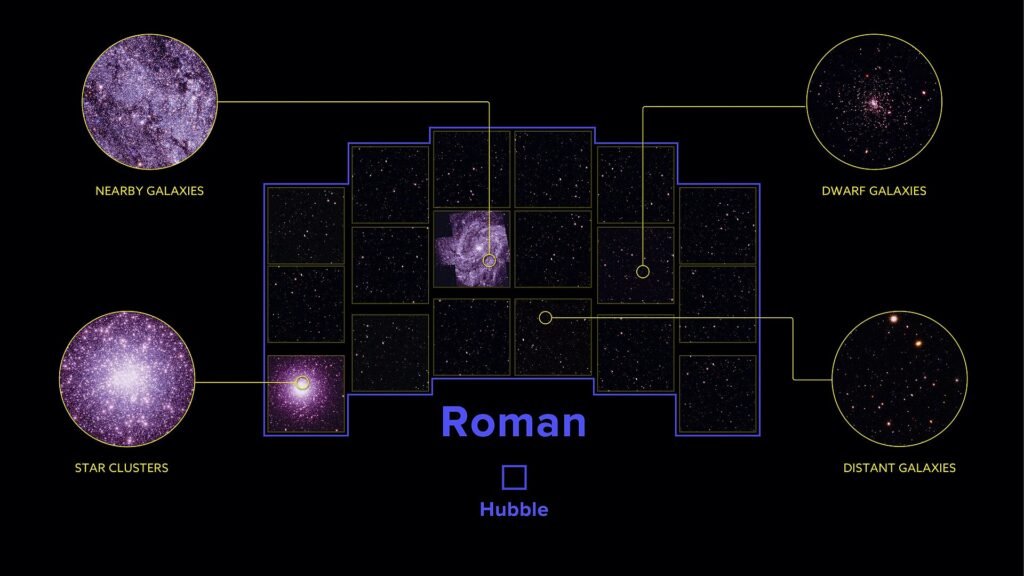
The successful launch of the Nancy Grace Roman Space Telescope aboard a SpaceX Falcon Heavy marks a pivotal moment for observational cosmology. Positioned at Lagrange point 2, approximately one million miles from Earth, Roman is designed to provide an unparalleled wide field of view, enabling it to survey billions of galaxies at a pace far exceeding its predecessors, such as the Hubble telescope. This capability is specifically engineered to address some of the most profound unresolved questions in astrophysics, primarily concerning the nature of dark energy, the distribution of dark matter, and the prevalence of exoplanets.
The scientific community currently operates largely under the Lambda-CDM (Lambda-cold dark matter) model, which posits dark energy as a cosmological constant driving the universe's accelerated expansion. However, persistent discrepancies, notably the 'Hubble tension' – the differing values for the universe's expansion rate derived from early universe observations versus local measurements – suggest that our understanding may be incomplete. Roman's mission, therefore, is not merely to confirm existing theories but to provide the granular data necessary to either validate or fundamentally challenge them. The sheer volume and precision of its expected observations by 2030 could either solidify the Lambda-CDM framework or necessitate a significant revision of our cosmic narrative.
Scenario one: The Lambda-CDM Refinement
Under this scenario, data from the Roman Telescope, by 2030, would largely align with the predictions of the existing Lambda-CDM model, albeit with minor adjustments. The wide-field surveys of distant galaxies, supernovae, and weak gravitational lensing effects might provide more precise measurements of the dark energy equation of state, confirming its nature as a cosmological constant within tighter error bars. The 'Hubble tension' might see a marginal reduction, or its persistence could be attributed to systematic errors in current measurement techniques rather than requiring new physics. This outcome would suggest that while our understanding of the universe's large-scale structure is largely correct, the Roman data offers crucial refinements, enhancing the predictive power of the standard model without necessitating a fundamental theoretical overhaul. The primary impact would be a consolidation of current cosmological theories, with research efforts shifting towards understanding the microphysical origins of dark energy within the established framework.
Scenario two: Emergence of New Dark Energy Physics
A more transformative outcome would see Roman's observations, by 2030, reveal significant deviations from Lambda-CDM predictions, pointing towards a dynamic form of dark energy or an entirely new cosmological component. This could manifest as a measured dark energy equation of state that evolves over cosmic time, or as discrepancies in the growth of cosmic structures that cannot be explained by cold dark matter alone. Such findings would necessitate the development of 'new physics' beyond the standard model, potentially involving modifications to general relativity on cosmic scales or the introduction of novel fields. The 'Hubble tension' might intensify, or new tensions could emerge, challenging the very foundations of our current cosmological understanding. This scenario would trigger a scramble among theoretical physicists to formulate alternative models, leading to a period of intense theoretical innovation and potentially a paradigm shift in how we conceive of the universe's ultimate fate and composition. The implications would extend beyond cosmology, potentially influencing particle physics and quantum gravity research.
Scenario three: Exoplanet Gold Rush and Biosignature Detection
While Roman's primary mission focuses on dark energy and dark matter, its exoplanet survey capabilities are substantial. This scenario posits that by 2030, Roman's observations would lead to an unprecedented increase in the catalogue of confirmed exoplanets, particularly those in the habitable zones of their host stars. Its high-contrast imaging and coronagraph technology could yield the first direct spectroscopic evidence of biosignatures in the atmospheres of Earth-like exoplanets, such as oxygen or methane in proportions inconsistent with abiotic processes. This would shift the focus of astronomical research significantly towards astrobiology and planetary science, potentially triggering a profound societal and philosophical re-evaluation of humanity's place in the cosmos. While not directly challenging cosmological models in the same way as dark energy findings, the discovery of extraterrestrial life, even microbial, would constitute a scientific breakthrough of immense magnitude, redirecting funding and research priorities across multiple disciplines. It would also prompt a re-evaluation of the 'rare Earth' hypothesis and the factors necessary for life to emerge and thrive.
Wildcards that would break every scenario
Several unforeseen developments could fundamentally alter or invalidate the trajectories outlined in these scenarios. A critical wildcard would be a significant technical malfunction or mission-ending event for the Roman Telescope, which would halt data collection and delay or prevent the anticipated discoveries, pushing back any potential paradigm shifts by decades. Conversely, an unexpected, anomalous observation that defies all current theoretical frameworks – a true 'black swan' event – could emerge within the first few years of operation. For instance, the detection of gravitational waves from an entirely new class of cosmic phenomena, or a direct observation that unequivocally contradicts fundamental tenets of physics (e.g., the constancy of physical laws across cosmic time), would render existing models and their incremental refinements obsolete. Furthermore, a breakthrough in terrestrial particle physics that definitively identifies the nature of dark matter, independent of astronomical observation, could pre-empt or profoundly contextualise Roman's findings on cosmic structure. Finally, a rapid, unpredicted advancement in AI-driven data analysis could accelerate discovery timelines, allowing for insights to be gleaned from Roman's data far sooner and with greater complexity than currently anticipated, potentially compressing the decade-long forecast into a much shorter period.
Strategic implications
The strategic implications of Roman's mission, reaching into 2030 and beyond, are far-reaching. For scientific funding bodies, the outcomes will dictate future investment priorities: either consolidating resources behind established cosmological frameworks or reallocating them towards novel theoretical physics. Should Roman confirm the Lambda-CDM model with greater precision, it would likely spur investments in next-generation telescopes designed to probe even deeper into the early universe or with even higher resolution. If new dark energy physics emerges, there would be a strategic imperative to fund theoretical research into alternative gravity theories and exotic fields, potentially impacting the direction of particle physics programmes globally. The exoplanet scenario carries distinct implications, particularly for astrobiology and space exploration. A confirmed biosignature would likely trigger a strategic pivot towards targeted follow-up missions and the development of technologies for in-situ analysis of potentially life-bearing worlds. Beyond scientific implications, a breakthrough in understanding the universe's fundamental nature or the discovery of extraterrestrial life could profoundly influence public perception of science, education curricula, and even geopolitical narratives, potentially fostering a sense of shared human endeavour or, conversely, sparking new philosophical and ethical debates. The decade to 2030 will therefore not only be about what Roman sees, but how those observations fundamentally reorient humanity's strategic pursuits in science and beyond.
Scenario matrix
| Scenario | Probability | Confirming trigger |
|---|---|---|
| The Lambda-CDM Refinement | 55% | Initial Roman data by 2027-2028 shows a dark energy equation of state consistent with a cosmological constant within improved error margins, and the Hubble tension either reduces or is explained by resolved systematic errors in other datasets. |
| Emergence of New Dark Energy Physics | 30% | Roman's 2027-2028 data reveals a statistically significant and persistent deviation in the dark energy equation of state from a constant, or unexpected anomalies in the growth of cosmic structures that cannot be reconciled with the Lambda-CDM model. |
| Exoplanet Gold Rush and Biosignature Detection | 15% | By 2028-2029, Roman directly images and spectroscopically identifies atmospheric biosignatures on multiple exoplanets in habitable zones, confirmed by independent follow-up observations if possible. |
Probabilities are estimates, not certainties. They are published so the forecast can be scored later.
Source material: Bloomberg Markets